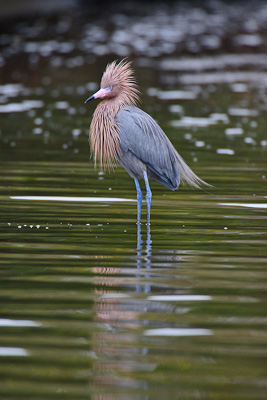
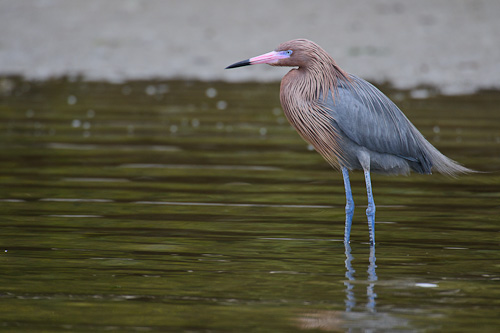
Reddish Egrets became a new specimen to add to my files this winter. I was fortunate to find several at the Audubon Sanctuary in Tampa Bay. Reddish Egret lookng for love
The photographs above and below show the Reddish Egret in his breeding plumage. Reddish Egret eyeing a meal
It was great to have a chance to add this terrific bird to my list of birds I have photographed. Alas, because the weather was rainy, I will have to go back to Florida and try to add a few shots with some sweet light!
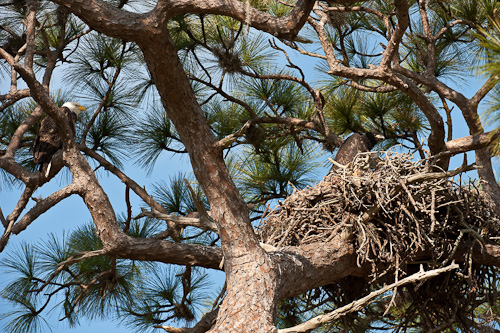
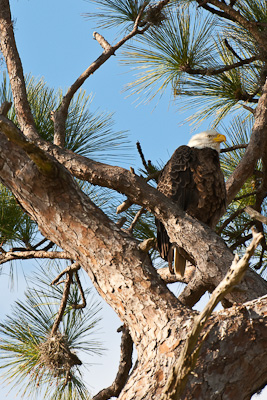
One of the highlights on my recent trip to Florida to photograph migrating birds was spending time at an American Bald Eagle nest. Male American Bald Eagle watching over nest with 2 chicks
With this being my first time photographing American Bald Eagles, I was hopeful to learn some biology as well as come away with a few shots worth keeping. There was some interesting history associated with this nest. Apparently American Bald Eagles are very good parents. 2 weeks prior to our arrival, an Audubon biologist climbed this pine tree and placed an orphaned chick in the nest with the biological chick. The result? The mother and father took to the orphan just like there own. The only difference was double the fish to catch! Male American Bald Eagle in Pine Tree
Given the beautiful weather it was a pleasure to be outside this morning. In fact this was the nicest of the mornings we had to date. There were also some local photographers and bird enthusiasts around so picking up some local knowledge about the nest was easy.
It was however a little strange waiting for the sweet light at sunrise. You see this nest is in a cemetery!
I wish I were able to show you closer images but I had equipment trouble at the end of the trip and my lens was just not long enough. The story of my life!
There are several blogs and websites I read regularly. Most of you who know me can surmise that they are either photography or business sites. When I read Scott Bourne’s posting today I just had to share it with all of you. Here is the LINK. I hope it moves you the way it did me.
We had a great start to photographing birds in Florida. Our first trek brought us to Maximo Beach & Park. While the weather was cool, the skies were blue and the sun rose to kiss our subjects with beautiful warm light.
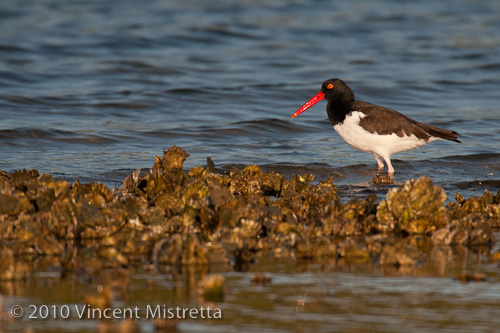
American Oyster Catcher on Bed of Oysters
The American Oyster Catcher was one of the birds I hoped to photograph. We were lucky to have this one present itself on a bed of oysters!
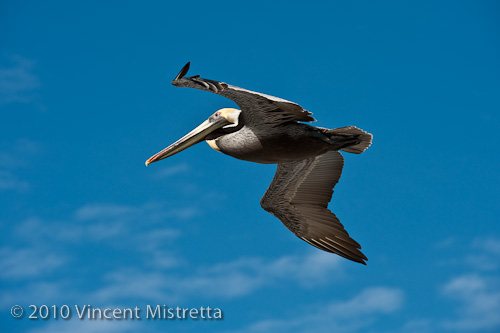
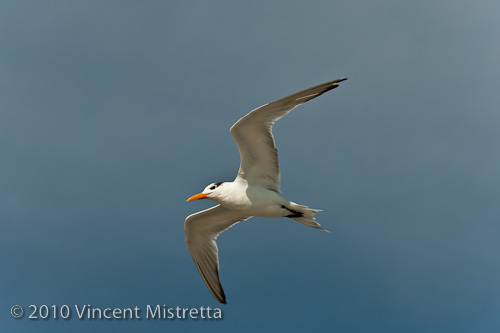
The afternoon found us at a fishing pier working on our panning and bird flight photography. The main characters present were the Florida Brown Pelican, Royal Tern and Laughing Gulls. Brown Pelican on Pier Florida Brown Pelican in flight Royal Tern in flight
Since returning from Africa, I have been asked by several readers about the process of preparing for a Wildlife and Nature photography trip. As I prepare to leave for a week in sunny Florida to photograph migrating birds, I thought it would be useful to explain what I am taking and how I am getting it there.
Like many photographers I suffer from having tried and owned too many camera bags. The simple truth is that we all spend far too much time trying to get everything to fit into one kind of bag. Once I realized that the bag I used for a given trip or assignment needed to be approached in the same way I selected lenses, flash and other accessories, it was like a light went off over my head.
I basically have settled on 3 bags for all my gear. Two of the bags I use are made by someone I consider a mentor, Moose Peterson. The largest of the bags is the MP-1. This bag is a work horse for me and is what I carry when I need to take everything and the kitchen sink. It is also accepted as carryon luggage on regional airlines which in todays traveling world is not only important but a necessity. The next bag I use as my walk around pack is the MP-7. This bag doesn’t look like a camera bag and is light weight and easy to carry anywhere. I can also bring this to events in my checked luggage and break down the MP-1 into this smaller pack for ease of carrying. I consider both these bags must haves for my photography.
The last of the bags I use regularly is made by Gura Gear. The Kiboko is a bag I use in 2 specific situations. 1) I need a bag with good support for heavy loads and when/where hiking is required. 2) I want to have 2 bodies with lenses attached ready to go. This is particularly important when I am in very dusty conditions or poor weather and don’t want to expose my sensor to dust when changing lenses. The Kiboko bag is also accepted as carryon luggage for regional jets. This bag is strong, roomy and has a great layout internally and in the outside pockets.
All 3 of these bags are very well made and come with strong guaranties from their suppliers who are also great photographers. This last element means these bags are designed by people who use them, they live an die by their bags performances.
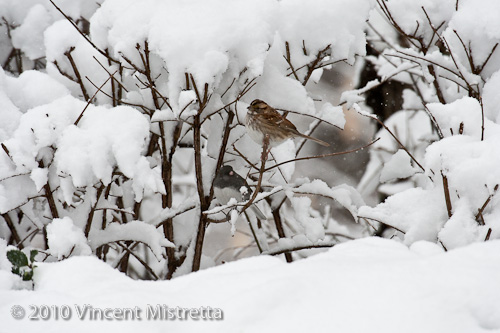
The recent snow storms along the Eastern U.S. left many people without power, telephone and dare I say it, internet service! The snow was so heavy on Friday there wasn’t even places for the birds to hide.
Black Eyed Junco and White Throated Sparrow in snow storm
I decided to venture out on Friday because photographing landscapes and wildlife is usually better in bad weather, much to the chagrin of the photographer. The other reason I went outside was I had seen from the kitchen window something I had never seen before. During the storm, a flock of approximately 50 European Starlings attached our bird feeders. The tree was completely covered in them. I quickly found that these birds are very skittish when it comes to people. As soon as I opened the door to go out, they flew away without me being able to make 1 click.
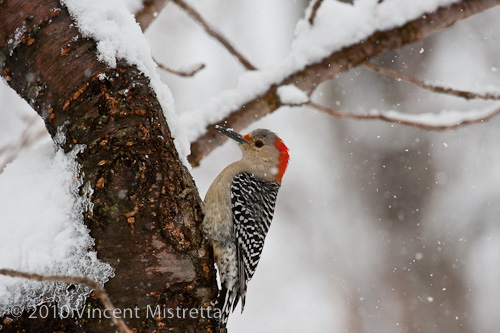
However, as the saying goes, all clouds do have a silver lining. As I was standing under the tree with the feeders, a Red Bellied Woodpecker flew right past my head and landed in the tree. I have been trying to photograph this bird for a year. Like the Starlings, the Red Bellied Woodpeckers don’t like people. But the combination of the commotion of the swarm of birds and heavy snow was enough to camouflage me. I was able to get the lens up before the bird knew I was there. He didn’t stay long however, just long enough.
Red Bellied Woodpecker in tree during Snow Storm
As I mentioned before I try to use the bad weather to take some landscape photographs. I tried my hand with a few black and whites which I thought made sense given the overcast skies and heavy snow. Japaneese Maple covered in Snow
I love trying to find interesting patterns that occur in nature. They are always there and are always changing.
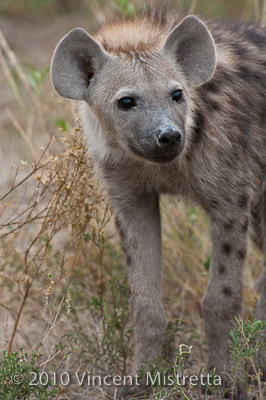
My African safari was full of great memories. One of the best finds by our guide was a Spotted Hyena den chock full of pups of various ages. Hyena Pups at Den Hyena Pups with Runt
How we happened upon this den was an exciting story. On our first game drive in Botswana, we happened upon a pack of African Wild Dogs. When it became too dark to photograph let alone see, we started our journey back to camp for the night. No sooner had we packed up our gear when we heard the dogs and hyena fighting. We turned on the spotlights on the jeep and headed toward the noise. It seems as the dogs were making their way, they happened upon the hyena den and a territorial spat ensued. While we couldn’t make any clicks with our cameras, we now had a new location to scout over the coming game drives.
The next day we returned to the den to find only pups, no parents! It truly amazed me how these pups took care of themselves while their parents were out gathering food. We worked this area for an hour or so. As the pups became more comfortable they came very close to our vehicle. They are very photogenic animals. Hyena Pup
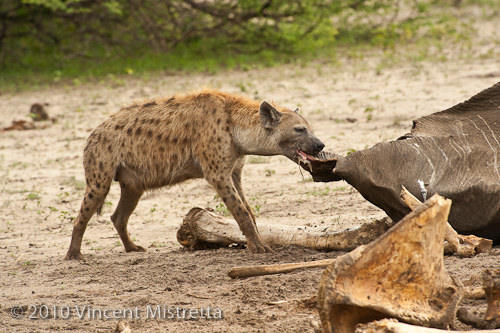
On our last game drive at Chitabe, we happened upon one of the adult Hyena picking over the remains of an Elephant. Was this soon to be lunch for the Hyena Pups? We couldn’t tell you as we had a flight to catch! Hyena at Elephant Carcass
I have been working on a series of posts about what is involved in preparing for an African Safari. I have received a lot of inquiries in this regard and I figured putting together all the emails into a post or two would be useful. Stay tuned!
Those who know me know I love the beach, especially those on Long Island. I will always consider Long Island home even though I no longer live there. I chose to head out to Quogue to visit my parents this weekend, President’s weekend, given my daughter was off from school. I was amazed at how quiet it was. All the better for us!
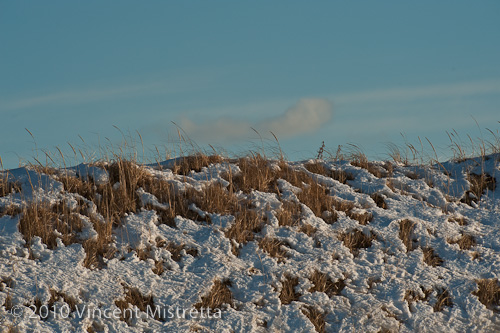
New snow had fallen and the landscape photography was excellent.
Snow Spotted Sand Dune
Away from visiting with my parents, one reason I went out to Long Island this weekend was for the bird photography opportunities. With no one around I knew I would have ample time to work areas with minimal interruption from cars or beach goers, a luxury not afforded during the summer months.
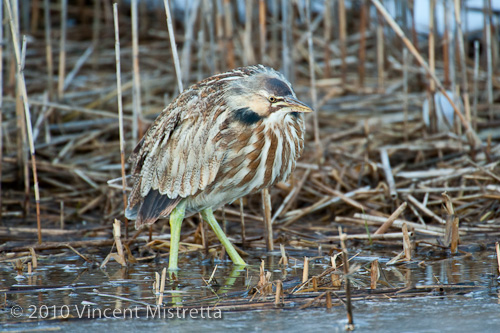
The biggest “find” I had for the weekend was spotting a lone American Bittern at a very small salt marsh. It was truly amazing that I was able to catch this bird out of the corner of my eye while driving. You can see from the picture that he is camouflaged well with his surroundings.
American Bittern in Salt Marsh
This was my first chance to photograph an American Bittern. Observing its behavior and hunting style was a thrill. Unfortunately I only came away with a few marginal pictures. I was experiencing some focusing problems with my camera combination, a Nikon D700 and 200-400 f/4 with 1.7 TCe. I’m not sure if the error was operator induced or mechanical but most of the issues were back focusing so I am thinking I need to calibrate the camera and lens combination.
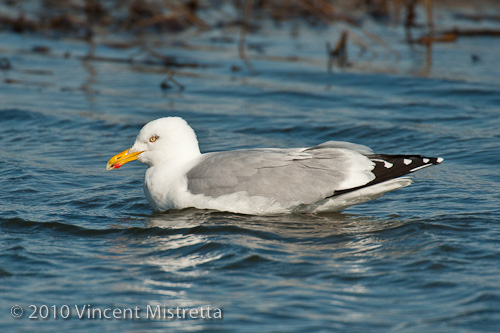
Another cool behavior I was able to witness for the first time was courtesy of the Herring Gulls. Floating Herring Gull
This flock of Herring Gulls would dive for clams and crabs, fly to an area where the bay was covered in ice, and from about 50 ft. in the air, drop their catch on the ice. This would have the effect of breaking the shells and stunning the prey so the gull could make quick work of eating the insides. It was amazing to watch this behavior over and over again.
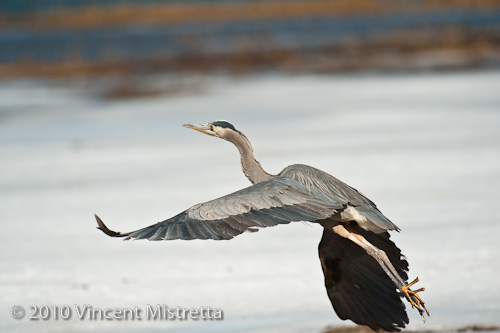
On my way back from a great morning of photographing birds, I spotted a Great Blue Heron heading out to the bay. I just had to stop and make one more click! Great Blue Heron in flight
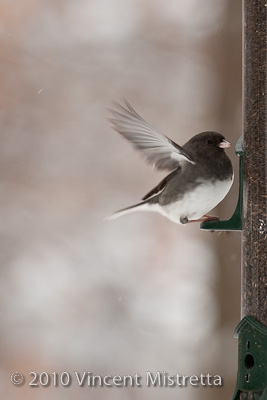
One of the nice surprises of the winter has been the appearance on our property of a flock of Dark Eyed Junco’s. After doing some research it seems that these birds are very loyal, as in once they make your property home good luck in getting rid of them! Dark Eyed Junco Eating Holly Berries
They have been a lot of fun to watch. They swarm and communicate just like any busy family. I might even try to capture some video of this as pictures don’t do the interaction justice.
But then a funny thing happened. Last week, several of these birds mysteriously started to kamikaze into our windows. We couldn’t figure out what it was but came to the conclusion that the sun at this time of year must have put a funny reflection into the sliding doors and the birds thought they were flying to another tree. Mystery solved, or so we thought.
Then over the weekend I was watching the activity at the feeders from the family room. All the birds seemed uneasy. In an instant they scattered and from over the house came a red tailed hawk. The hawk grabbed one of the Junco’s out of mid air, perched on a nearby tree, bit the head off of the Junco and flew away. So much for my “sun in a different part of the sky” theory. So it seems the birds were fleeing from the hawk when they hit the sliding doors.
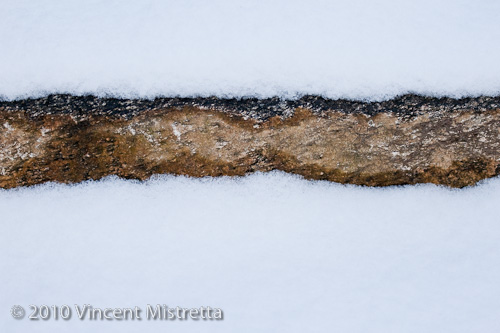
As I am sure many of you have heard, the eastern U.S. is in the midst of a heavy snow storm. Stone Wall Covered in Snow
Given that the Junco’s are black and gray, I am watching to see if the hawk uses the snow to help isolate some of the birds. So far no sign of the hawk.